
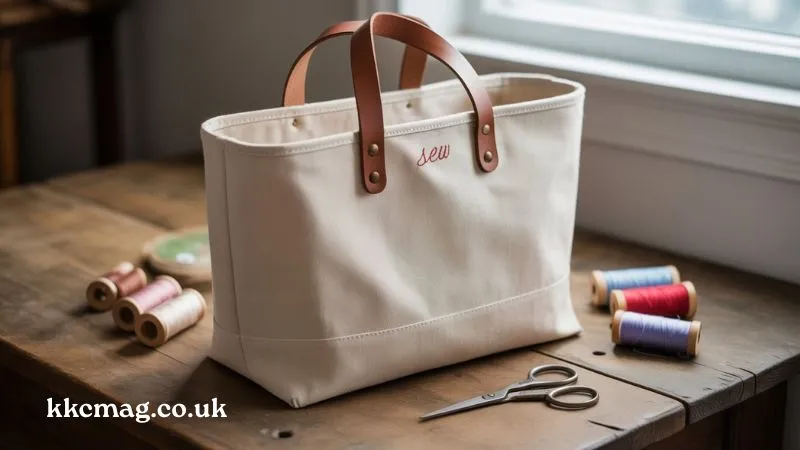
Tote bags are the ultimate “make once, use forever” sewing project. They’re simple, practical, and endlessly customizable. A basic flat tote works for light errands, but if you want something sturdier that can hold its shape, a tote with a flat bottom is the way to go. That flat base creates structure, letting the bag sit upright and giving you more room inside for groceries, books, craft supplies, or even your laptop.
If you’ve been meaning to try sewing your own tote, this project is beginner-friendly but still produces a bag you’ll actually use. Let’s walk through everything step by step.
Materials You’ll Need
Choosing the right materials will make your tote last longer and look more polished:
- Fabric for the outside – A sturdy option like canvas, denim, twill, or even home décor fabric works best. You’ll need about ½ yard.
- Lining fabric (optional) – Quilting cotton or lightweight broadcloth can give the inside a neat, professional finish. Another ½ yard is enough.
- Thread – Match your fabric color or use a contrasting thread for a decorative look.
- Handles – You can sew your own using matching fabric strips or use cotton webbing for extra durability.
- Basic sewing tools – Sewing machine, fabric scissors or rotary cutter, ruler or measuring tape, pins or clips, and an iron.
Tip: If you plan to carry heavier items, consider adding interfacing between the layers to make the bag even stronger.
Step 1: Cut Your Fabric
Decide on the size of your finished tote. For a roomy everyday bag, try a 16″ wide × 14″ tall tote with a 4″ flat bottom.
- Cut two rectangles of your outer fabric, each 18″ wide × 16″ tall. This measurement includes seam allowance and accounts for the boxed corners.
- Cut two rectangles of the same size for the lining (optional).
- For the handles, cut two strips of fabric 22″ long × 4″ wide.
If you want shorter or longer straps, adjust the length. Handles around 22″ let you carry the tote comfortably over your shoulder.
Step 2: Make the Handles
- Take one handle strip and fold it in half lengthwise with the right side facing out. Press with an iron.
- Open it back up. Now fold each raw edge in toward the center crease. Press again.
- Fold the strip back along the center crease so all raw edges are hidden. You’ll now have a 1″ wide strap made of four layers of fabric.
- Stitch down both long sides, close to the edges, to secure the folds. This also adds strength.
Repeat for the second handle.
Shortcut: If you’re using cotton webbing instead, simply cut it to your desired length — no sewing required.
Step 3: Sew the Outer Bag

- Place your two outer fabric rectangles right sides together.
- Pin along both side edges and the bottom edge.
- Sew with a ½” seam allowance.
- Press the seams open with an iron to reduce bulk.
Repeat the same steps with the lining fabric. If you’re making a lining, remember to leave a 4″ opening in the bottom seam so you can turn the bag right side out later.
Step 4: Box the Corners (Flat Bottom)
This is the step that turns your flat tote into a structured one.
- Starting with the outer bag, pick up one bottom corner. Pinch it so the side seam lines up with the bottom seam, forming a neat triangle.
- Lay the triangle flat. Use a ruler to measure 2″ down from the tip and draw a line straight across.
- Sew along that line. Trim the excess triangle off, leaving about ½” seam allowance.
- Repeat for the other bottom corner.
- Do the same for both corners of the lining.
Now your bag pieces will naturally stand up with a boxy base.
Step 5: Attach the Handles
- Turn the outer bag right side out.
- Position one handle end on the top edge of the bag, about 4″ in from the side seam. Pin in place.
- Repeat with the other end of the handle, making sure the strap isn’t twisted.
- Do the same with the second handle on the opposite side of the bag.
- Baste (sew temporarily with a ¼” seam allowance) to hold the straps in place.
Step 6: Sew the Outer Bag to the Lining
- Keep the outer bag right side out. Turn the lining inside out.
- Place the outer bag inside the lining so the right sides are facing each other. The straps should be sandwiched between the layers.
- Line up the side seams and top edges, then pin all around.
- Sew around the entire top edge with a ½” seam allowance.
Step 7: Turn and Finish
- Pull the outer bag through the opening you left in the lining.
- Stitch the opening in the lining closed — either with a straight machine stitch close to the edge or with a ladder stitch by hand.
- Push the lining inside the bag, making sure the corners sit neatly at the bottom.
- Press the top edge flat with an iron.
- For a professional finish, topstitch around the top edge about ⅛” from the seam. This reinforces the straps and keeps the lining from rolling out.
Also Read: Clean a Marc Jacobs Tote Bag
FAQs About Sewing a Tote Bag with a Flat Bottom
Can I sew this tote bag without a lining?
Yes. A lining makes the bag look neater and more durable, but you can skip it if you want a faster project. If you go without, finish your seams with a zigzag stitch or pinking shears to prevent fraying.
What kind of fabric works best for tote bags?
Medium to heavy weight fabrics like canvas, denim, upholstery fabric, or cotton twill are ideal. If you’re new to sewing, avoid very slippery fabrics like satin — they’re harder to control.
How do I make the bag sturdier?
You can add fusible interfacing to the outer fabric or lining before sewing. Another option is to slip a stiff insert (like a piece of plastic canvas or cardboard) into the base to keep it flat.
Can I adjust the size of the bag?
Absolutely. Just cut larger or smaller rectangles at the beginning. Remember: the depth of the bottom is set by how far you measure in when boxing the corners. For example, sewing 3″ in from the corner gives you a 6″ wide base.
Final Thoughts
That’s it — you’ve just sewn a tote bag with a flat bottom! This style of tote is far sturdier than the flat variety and can hold everything from groceries to knitting supplies. Once you’ve mastered the basic construction, you can customize your bags by:
- Adding a pocket or two on the inside or outside.
- Using contrasting fabrics for the lining and straps.
- Playing with size — make a giant version for the beach or a smaller one for lunch.
- Reinforcing the bottom with interfacing or even inserting a removable base piece for extra support.
Not only will you have a reliable bag you can use daily, but you’ll also gain a skill you can repeat again and again. Handmade totes also make thoughtful, practical gifts.

Harlod is blogger, creative writer, and SEO specialist dedicated to crafting engaging content. With a passion for storytelling and digital growth, he combines creativity and strategy to help brands connect with audiences.